what science teachers need to know about udl
 What are some UDL essentials to know as you're getting started with this highly effective approach to teaching? Today'southward post shares a few insights from the 2nd edition of Pattern and Deliver, the go-to primer on universal design for learning for busy teachers looking to meliorate every learner's outcomes. Here are four things author Loui Lord Nelson identifies as foundational concepts for educators starting their UDL journey.
As yous footstep into the framework, notice one affair that feels right to endeavor and get with that showtime.
It's best to brainstorm slowly. Taking on something as big and flexible as UDL can experience overwhelming, and can easily feel like "one more thing" in your already packed schedule. As yous step into the framework, discover one thing that feels right to effort and become with that beginning. You can add to that one thing slowly, over time. Loui Lord Nelson recommends a few different ways you tin can approach your new relationship with UDL:
- Focus on 1 of the UDL guidelines and select tools, resource, or strategies based on that guideline.
- Focus on one of the UDL principles (appointment, representation, activeness & expression) to begin a full general exam of your lessons and classroom/environs.
- Brainstorm your lesson development by asking, "How does this activity connect back to my lesson goal?"
- Review yesterday's lesson using the information yous learn about the principles
- Listing the different tools and resources you tin already access. Remember to retrieve about things and people. Now, consider how those tools and resources can help yous put one or more of the principles into activity.
- Talk with fellow teachers about the principles and guidelines and how they approach UDL.
- Practise the aforementioned activities, just use that same list of tools and resources to call back virtually one or more than of the guidelines.
There is no end to learning virtually UDL.
It'south a continual process. At that place is no stop to learning about UDL. Information technology's a framework that continues to change because the research in education, psychology, and educational psychology will always continue to change and evolve. If you enter your experience with UDL knowing you'll always exist learning more, you'll take a flexible mindset that will help you come across the needs of your variable learners.
Keep in heed that UDL isn't something you "do," but something you employ to pattern your environment and your lessons. Loui recommends shifting the question from "When will I know I am doing UDL?" to "When will I know I take used UDL to its fullest?" The respond is:
- When you've made conscious decisions to design your didactics space and lessons using tools, resource, and strategies that align with the options suggested inside the framework.
- When you conspicuously identify the goal for your lesson and connect the subsequent activities with that goal.
- When y'all realize that past using the options suggested within the UDL framework, you're opening the doors to learners who are not typically included in traditional designs.
The barrier is not inside the learner—the barrier is how the learning surroundings is designed.
Information technology's for all learners. The assumption with UDL is that every learner tin can and should make choices and investigate their ain learning needs. UDL is about providing consciously selected and researched options to all learners so they tin can ultimately acquire to guide their own learning. Always remember that the barrier is not within the learner—the barrier is how the learning environment is designed. When yous lower those barriers and requite your students the breadth to create and demonstrate their knowledge, what they generate will astound you.
UDL is not discipline dependent; it tin can be practical effectively in whatever instructional setting, and with any academic discipline.
It tin can be used to design for all subjects. UDL is not subject dependent; it can be practical effectively in any instructional setting, and with any bookish subject field. Literacy and composition are at the base of all subjects, and UDL supports both of those—but UDL goes further in how it aligns with the needs of students' acquire¬ing, including scientific discipline, technology, engineering, arts, and mathematics (STEAM).
Pattern and Deliver includes plenty of vivid examples that show how to utilize UDL to design a variety of lessons across different educational settings and subjects. And in Loui Lord Nelson's UDL in 15 Minutes podcast, she interviews a wide range of educators who are implementing UDL in their learning environments, including:
Kim Babeu, 2005 Arizona Teacher of the Year, who discusses how she uses UDL to provide her high school students with more than choice as they prep for and take their beefcake assessments.
Camille Wheeler, elementary school learning coach, who talks almost how she and the fourth class teachers she works with created a organisation based on the UDL principle of Activity and Expression to assistance learners testify what they know in English language Language Arts.
Ben Kelly, a Canadian 6-12 STEM teacher, who discusses what he and his team of teacher-researchers discovered about UDL when they conducted an action research study that included Minecraft as a learning tool.
Selena Andrade Gonzalez, a resource specialist at a bilingual and high need school, who talks about strategies for introducing UDL to full general pedagogy and using UDL principles to support altitude learning.
Use the examples these and other real-earth educators provide every bit inspiration every bit you get started with UDL, recognizing that you'll need to assess your current teaching state of affairs and suit your own approaches appropriately. Hither are a few free UDL resource to use on your journey:
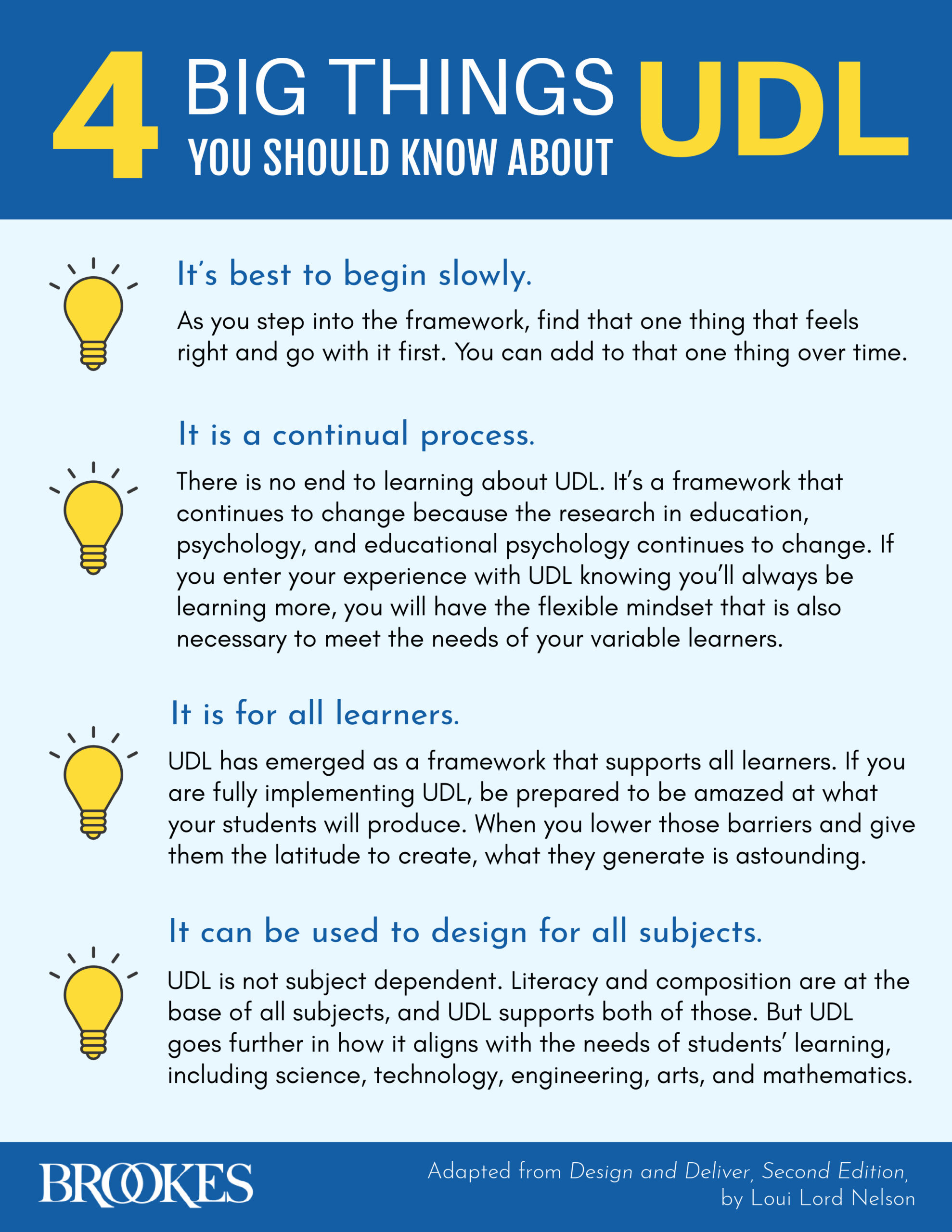
GET A FREE TIP SHEET
Proceed the concepts from today's mail close at mitt with this free printable one-sheet.
DOWNLOAD IT Now
GET Complimentary Resources
Refer to our post on 9 Free UDL Resources Every Teacher Should Know Well-nigh to discover some UDL gems.
SHARE THE GRAPHICS
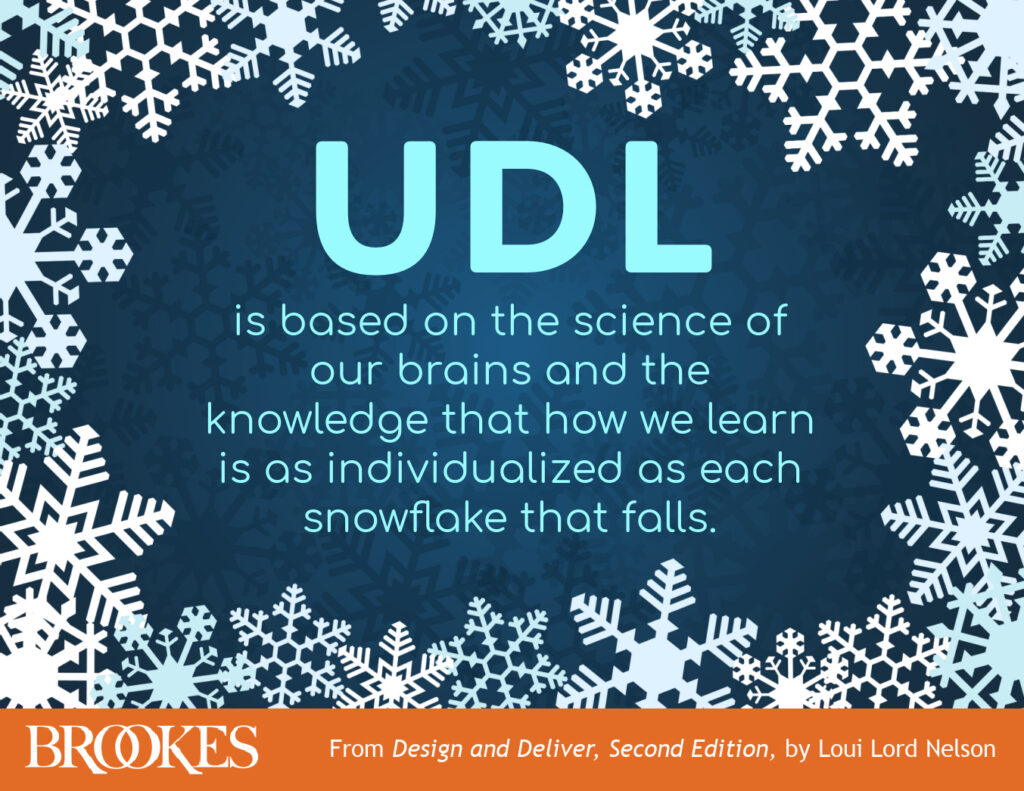
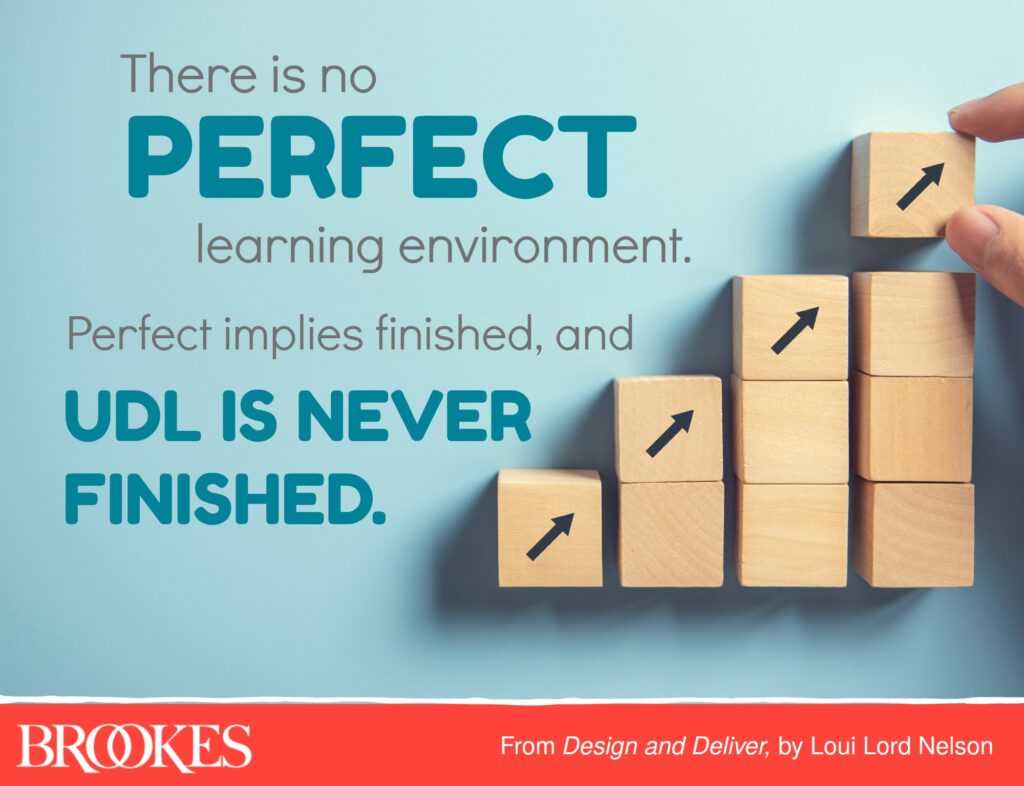
Here are a few graphics from Pattern and Deliver to share, pin, impress, and salve for inspiration.
Source: https://blog.brookespublishing.com/4-big-things-you-should-know-about-udl/

Post a Comment for "what science teachers need to know about udl"