Percentage of People That Dont Read the Terms of Service
Many Americans have little to no understanding of what companies are doing with the data that is collected about them. At the same time, nearly all Americans encounter companies' privacy policies at some betoken. This survey explores whether they fully read them and how much they understand about these policies.
Most Americans accept been asked to agree to a privacy policy; while many read them, relatively few read these policies regularly
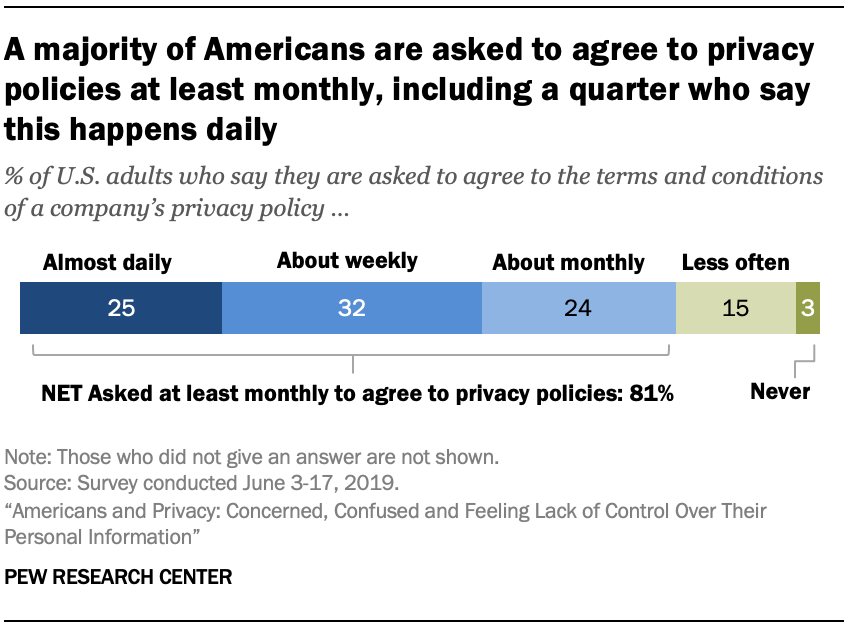 Privacy policies accept become a common characteristic of public life. One-quarter of adults say they are asked to concur to the terms and conditions of a company's privacy policy on an most daily basis, while 32% say this happens virtually once a week; another 24% say they are asked for this roughly in one case a month. In total, 97% of Americans say they have ever been asked to agree to the terms and conditions of a visitor'southward privacy policy.
While nearly all Americans are asked to agree to terms and conditions of a visitor's privacy policy, relatively few study reading these policies on a regular basis.
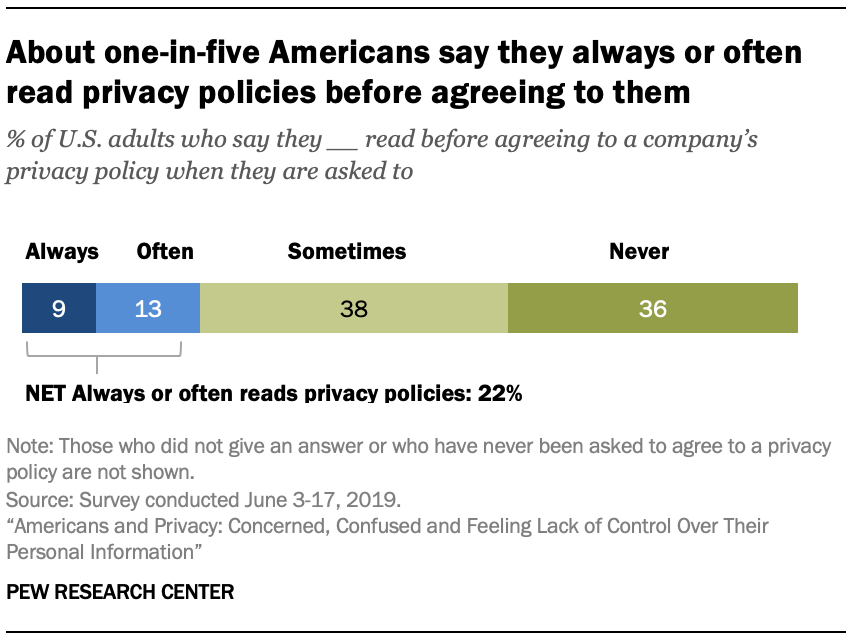
Just ix% of adults say they always read a company's privacy policy earlier agreeing to the terms and weather condition, while an additional xiii% say they do this often. And additionally, 38% of Americans say they sometimes read these policies. There is also a segment of the population who forgo reading these policies birthday: More than than a tertiary of adults (36%) say they never read a privacy policy before agreeing to it.
 There are some demographic differences in reading privacy policies. Fully 68% of adults living in households with an annual income of $30,000 or less say they e'er read privacy policies, compared with 52% of those whose family income is $75,000 or more a year. Women are more likely than men to say they e'er read a company'due south privacy policy before agreeing to it (65% vs. 55%). And adults ages 50 and older are more likely than those under 50 to e'er read privacy policies (65% vs. 56%).
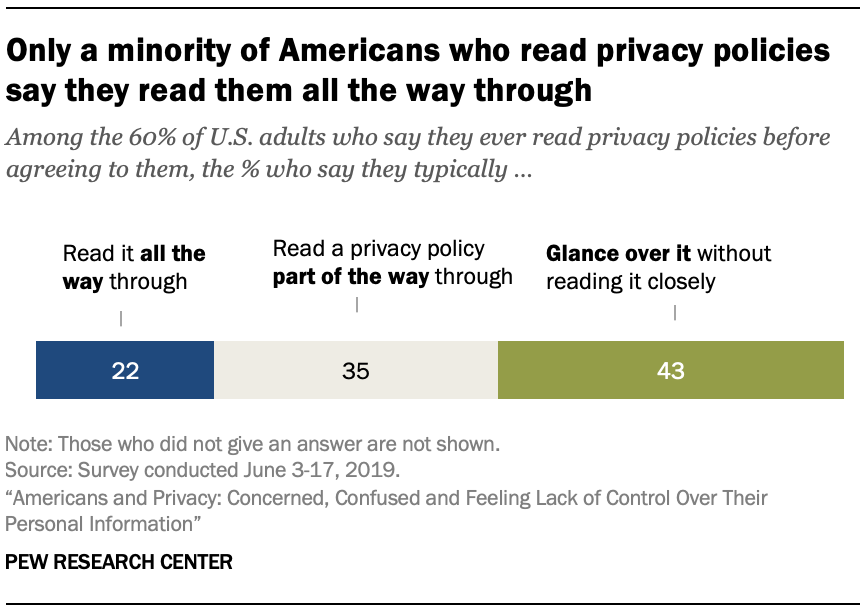 But the practice of reading privacy policies doesn't necessarily guarantee thoroughness. Among adults who say they ever read privacy policies earlier agreeing to their terms and atmospheric condition, only a minority (22%) say they read them all the way through before agreeing to their terms and conditions. It's more than mutual for these readers to say they either glance over it without it reading closely (43%) or say they merely read it part of the mode through. Among all U.S. adults, 13% say they read privacy policies all the way through, 21% read role of the way through and 26% glance over them.
There are few demographic differences among adults who read privacy policies in full. For case, those living in households with an annual income of $30,000 or less are twice as probable as those in households with an almanac income of $75,000 or more than to say they read all the way through (xxx% vs. 15%). And while 26% of adults ages 65 and older say they read privacy policies all the manner through, that share falls to 15% amongst those ages 18 to 29.
A majority of adults who read privacy policies say they typically understand them
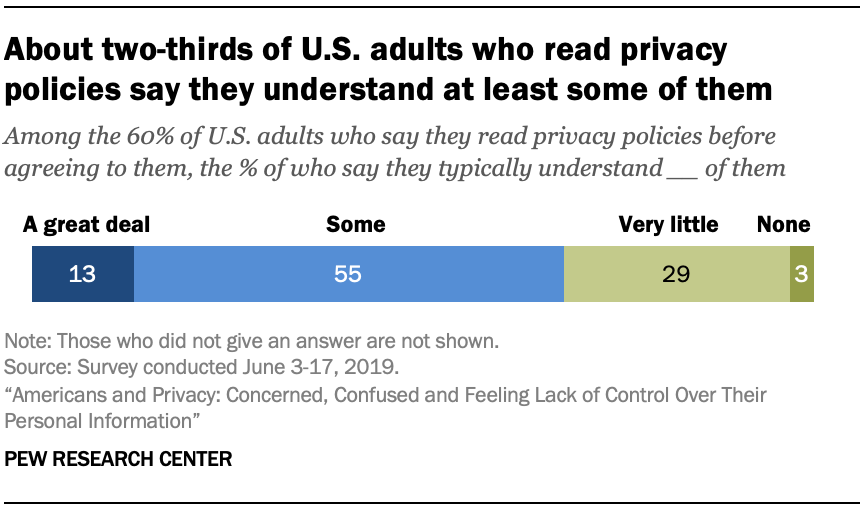 Roughly two-thirds of adults who read privacy policies say they typically understand a groovy deal (13%) or some (55%) of the policies that they read. However, about one-third of this group has a bottom grasp of the privacy policies they read, including 29% who say they understand very little and 3% who do non understand at all. Amid all U.Due south. adults, eight% say they understand privacy policies a great bargain, 33% understand some, 18% understand very niggling and 2% do not sympathise them at all.
Americans accept little confidence in companies' accountability with their information
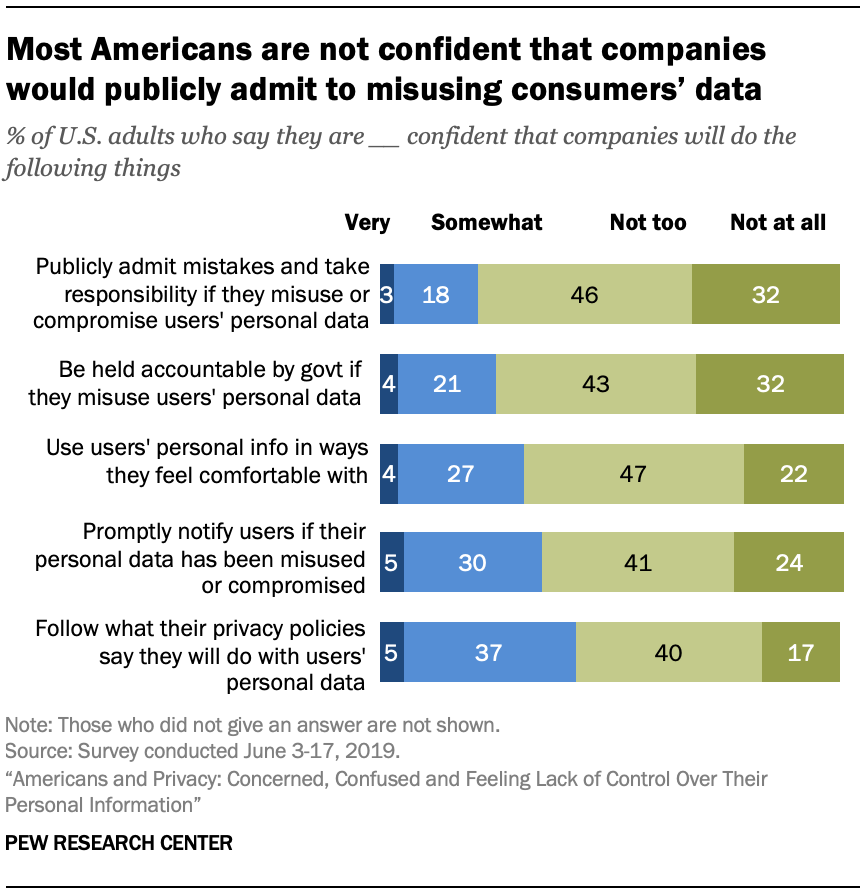 When asked how confident they are that companies will do sure things to protect them, relatively few Americans experience bodacious. In fact, clear majorities of adults prove picayune to no confidence that companies will follow through with certain actions.
Just 21% of adults say they are very (3%) or somewhat (18%) confident that companies will publicly admit mistakes and accept responsibility when they misuse or compromise their users' personal information, while 79% of adults are "not too confident" or "not confident at all" about this. A similar share (24%) are confident that a visitor will exist held accountable by the government if they misuse or compromise their information, while 75% are non confident about this.
Even though majorities even so take petty confidence in companies, about one-third of adults or more are at least somewhat confident in companies to use personal information in means they experience comfortable with (31%), promptly notify them if personal information has been misused or compromised (35%) or follow what their privacy policies say they volition do with personal information (42%).
Americans have varying levels of comfort with companies using their personal information in dissimilar ways
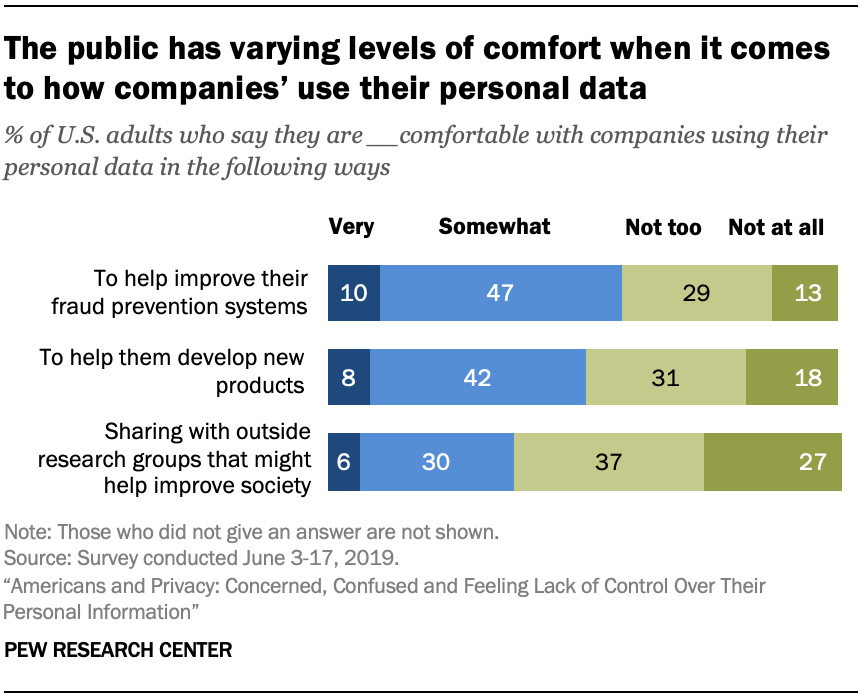 As a whole, the public feels more than comfy with companies using their personal information for sure purposes than others. For example, 57% of adults say they are very or somewhat comfortable with companies using their personal data to help companies improve their fraud prevention systems. Americans' views are split on companies using their personal data to help them develop new products: 50% are at least somewhat comfy, and 49% are not too comfortable or non comfy at all.
Adults are less positive toward other ways that companies may utilize their data. About a 3rd of adults (36%) say they are at least somewhat comfy with companies sharing their personal data with exterior groups doing research that might help them ameliorate club, merely a larger share (64%) say they would be uncomfortable with this practice.
Younger adults are generally more than comfortable with these uses of their private data, while older adults are less comfy. Adults under l years old are more likely than those who are 50 and older to exist at least somewhat comfortable with their personal data being shared with outside groups doing research that might help improve society (42% vs. 29%). By comparison, adults ages 50 and older are more likely than those under 50 to not exist comfortable with this (seventy% vs. 58%).
At that place are partisan differences on some of these companies' uses of personal information. Democrats, including independents who lean to the Democratic Party, are more likely than Republicans and Republican-leaning independents to be comfortable with companies sharing their personal data with outside groups doing research that might help ameliorate society (42% vs. 28%) and using their information to assistance amend their fraud prevention systems (61% vs. 54%).
Only about one-third of adults say they understand current data protection laws
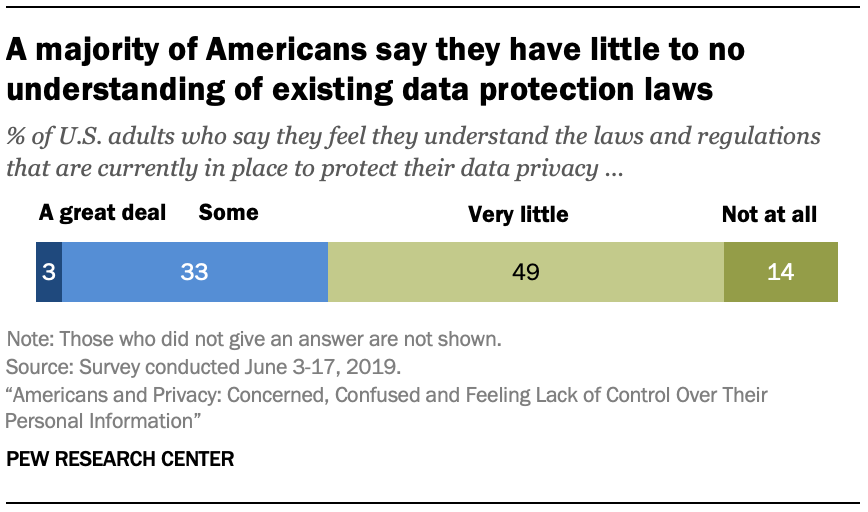 Americans were asked how much they empathise the laws and regulations that are currently in identify to protect their data privacy. Some 37% say they understand the laws and regulations some (33%) or a bully bargain (3%). Nearly two-thirds (63%) of adults say they practise not understand the laws and regulations that are currently in place to protect their data privacy. This includes 49% who say they understand the laws "very piddling" and 14% who do non understand them at all.
Americans who are more than knowledgeable about how their data is existence used are more probable to say they empathize privacy-related laws and protections. Among adults who have a great deal or some agreement of how companies use their data, 56% say they understand at least some about current data privacy protection laws and regulations; compared with 24% amid those who understand very little or zippo about how their data is used past companies.
A like pattern exists when it comes to government use of data: 59% of those who sympathize a great bargain or some most how their information is used by government say they empathize at least some about the data privacy laws and regulations versus xxx% among those who empathise very piffling or none about how their data is used. Adults who believe they don't benefit from how companies or the government uses their data are also more probable to have trivial understanding of these privacy laws.
Americans strongly favor more regime regulation of consumer data
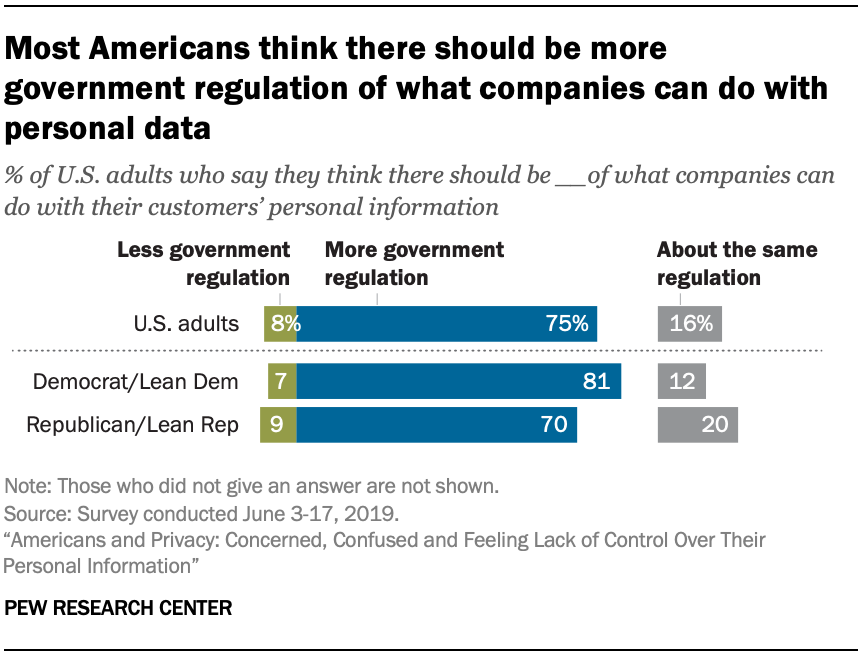 When asked how much government regulation at that place should be around what companies can do with their customers' personal information, 75% of adults say at that place should exist more regulation than there is now. About 1-in-ten (eight%) feel companies should be regulated less than they are now, while sixteen% say in that location should be the about same amount of regulation.
Although a majority of both Republicans and Democrats agree that companies use of personal data should exist regulated more than they are now, Democrats (including independents who lean towards the Democratic party) are more probable than Republicans and Republican leaners to believe in that location should be more regime regulation of what companies can do with their customers' personal information (81% vs. 70%).
There are also differences by the corporeality of attention people to privacy-related news. Adults who follow privacy news closely are besides more than likely than those who don't to say there should be more government regulation (79% vs. 68%).
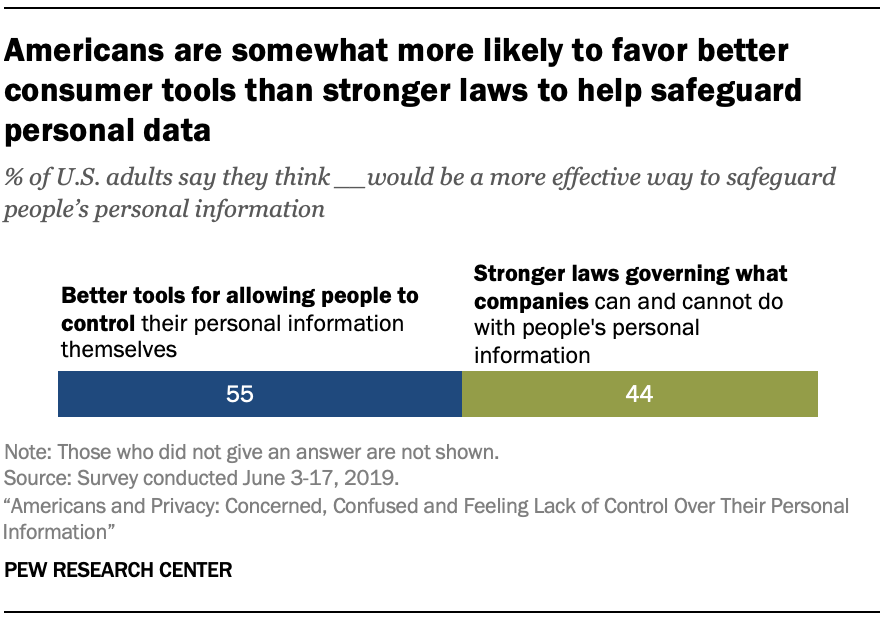 Merely when given a choice of whether they favor meliorate tools for consumers or stricter laws to safeguard people's personal information, a somewhat higher share of the public favored better consumer tools. Fully 55% of adults say amend tools for allowing people to control their personal data themselves would be a more constructive way to safeguard people'due south personal information. On the other hand, 44% of Americans say that stronger laws governing what companies can and cannot practice with people's personal information would be the more effective strategy.
Source: https://www.pewresearch.org/internet/2019/11/15/americans-attitudes-and-experiences-with-privacy-policies-and-laws/

Post a Comment for "Percentage of People That Dont Read the Terms of Service"