what doctor to see for ulnar nerve entrapment

Elbow Nerve Specialist

Are you experiencing pain, tingling, and a "falling asleep" or numb sensation in the little finger and ring finger? If so, yous may have ulnar nerve entrapment, or a pinched nerve in your elbow. Also called cubital tunnel syndrome, ulnar nerve entrapment tin can occur in several places forth the nerve path of the arm. Most symptoms are felt on the within of the elbow and extend to the fingers of the hand. It is very important to visit a doc at the onset of ulnar nervus compression symptoms to avoid musculus wasting. Ulnar nervus entrapment specialist, Md Riley J. Williams provides diagnosis every bit well every bit surgical and nonsurgical treatment options for patients in Manhattan, Brooklyn, New York Metropolis and surrounding areas who are experiencing the symptoms of a compressed or pinched elbow nerve. Contact Dr. Williams' team today!
What is ulnar nerve entrapment?
The ulnar nerve is 1 of three primary nerves of the arm. The ulnar nerve runs through the length of the arm and carries signals from the brain to the fourth and fifth fingers of the manus. This nerve courses from the base of operations of the neck, along the within of the arm, through the elbow and down to the fingers. Ulnar nerve entrapment is also known every bit cubital tunnel syndrome. An entrapped nerve is clinically the same as a pinched nerve. Entrapment of the ulnar nervus in the cubital tunnel of the elbow causes achiness, pain, tingling and numbness in the forearm and fingers. If left untreated, cubital tunnel syndrome tin can crusade muscle loss in the hand and forearm. The site where the ulnar nerve
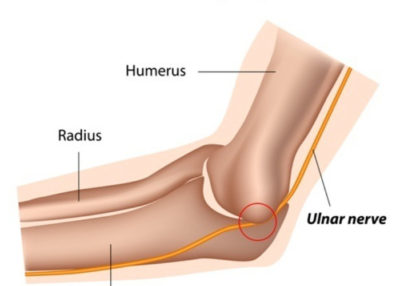
passes through the elbow (cubital tunnel) is narrow; the base of the tunnel is the bony portion of the medial epicondyle of the distal humerus. When the elbow is flexed, the ulnar nervus is stretched and compressed in the cubital tunnel, elbow extension reliefs this tension on the nervus. Though the cubital tunnel is the most common surface area of ulnar nerve entrapment in the arm, the nerve may be constricted in other areas of the arm besides.
What is cubital tunnel syndrome?
Cubital tunnel syndrome is ulnar nerve entrapment at the site of the medial epicondyle. The cubital tunnel is narrow and is comprised of a bony base of operations and an inflexible ligamentous sleeve. The ulnar nerve travels behind the medial epicondyle in the cubital tunnel. Constriction of the ulnar nerve in the cubital tunnel typically is exacerbated by elbow flexion or angle. Cubital tunnel syndrome tin issue in hurting, numbness and tingling in the forearm, hand and fingers; more astringent cases can result in a loss of full general motor function in the hand. Dr. Riley J. Williams, orthopedic elbow specialist serving Manhattan, Brooklyn, New York City, NY and surrounding areas has extensive experience in cubital tunnel syndrome and ulnar nerve entrapment.
What are the symptoms of cubital tunnel syndrome?
Individuals in the New York area who suffer from ulnar nervus entrapment or cubital tunnel syndrome often report the following symptoms:
- Forearm, paw and finger numbness and tingling
- Loss of motor skills in the mitt
- Loss of dexterity
- Pinky and band finger tingling/numbness
- Hand clumsiness
- Inability to hold things, resulting in dropping objects
- Worsening symptoms at night, stemming from sleeping in a flexed elbow position
- Pain or a burning feeling in the elbow or funny os (inner elbow)
How is ulnar nervus entrapment/cubital tunnel syndrome diagnosed?
Dr. Williams performs a concrete exam to check for tenderness, motor strength, and sensory changes in the manus, forearm and elbow. Longstanding cases of ulnar nerve tin present with muscle distal to the elbow. A diagnostic test, such as an electromyogram (EMG) will demonstrate the functionality of the ulnar nerve and determine where nerve compression may be located.
How is cubital tunnel syndrome treated?
Not-surgical treatment:
Conservative methods are typically the first line of handling for the ulnar nervus compression. Rest, elbow splints, and NSAIDs, such as ibuprofen, can aid reduce pain and inflammation. Physical therapy may be implemented to strengthen the arm muscles; occupational therapy can fine tune motor skills.
Surgical handling:
If nonoperative methods neglect or if cubital tunnel syndrome symptoms are longstanding, surgery is indicated. Dr. Williams performs ulnar nerve decompression and transposition on an outpatient basis. Calorie-free sedation and regional anesthetic are used during this surgery. An incision is made at the medial elbow, and the nerve is mobilized and cleared of all adhesions. The nerve tin can be left in the decompressed tunnel, or moved to a new location that is usually anterior to the cubital tunnel. It typically takes vi weeks to recover from ulnar nerve compression surgery.
For more than data on ulnar nerve entrapment, cubital tunnel syndrome and the handling options available, delight contact the part of Riley J. Williams, MD, orthopedic elbow specialist serving Manhattan, Brooklyn, New York Urban center, NY and surrounding areas.
Source: https://rileywilliamsmd.com/ulnar-nerve-entrapment-cubital-tunnel-syndrome-orthopedic-elbow-specialist-manhattan-new-york-city-ny/

Post a Comment for "what doctor to see for ulnar nerve entrapment"